
I grew up with music in the house before I understood what it was. My mother was once married to a well-known African musician, so sound was always in the air. Part of the furniture. Part of the mood.
By my teens I had found my own corner of it. Hip-hop.
I spent hours digging through crates of old records looking for one sample. Four seconds of a forgotten soul track nobody remembered. The craft was never in the four seconds. It was in hearing what they could become, then rearranging things that had no business sitting next to each other until somehow they did. You learned the lives of strangers through their lyrics. You gave a voice to people the world had stopped listening to. That was the whole point.
Then something shifted. Auto-tune arrived. Cloud rap. Mumble rap. At some point you did not really have to rap anymore.
I am not here to play the old head who says music was better in my day. Plenty of it now is brilliant. But I watched something get quietly optimized out of it, and for years I could not name what.
A researcher named Hubert Léveillé Gauvin eventually put a number on it.
He studied the songs that hit the top 10 from 1986 to 2015. The average song intro shrank from more than twenty seconds to about five. A seventy-eight percent drop. His explanation was simple and a little brutal. The skip button. When a listener can leave in one tap, the song learns to grab you before you go. The slow build, the instrumental promise, the part that asked for a moment of patience, all of it became a liability. His study, published in Musicae Scientiae, also found the first hook now arrives faster and the tempo runs hotter.
The decay did not start with AI. It started with us. We taught music to fight for its life in the first five seconds, because that is how we decided to listen.
Except “listen” is already the wrong word. We started consuming music instead of connecting to it. A song used to work its way inside you and stay there, become part of how you saw a year of your life. Now it gets a few seconds to audition, and if it does not grab, it is gone. When you stop letting a thing all the way in, you slowly stop loving it. And the moment a thing is no longer loved, it is easy to make by the yard. We optimized the soul out ourselves, long before a model could generate a single bar.
So when people ask me whether AI is going to ruin music, I think they are asking the wrong question. The more honest one is the question I want to put to my first podcast guest. If we were already letting the soul leak out, why fight for human-made music at all?
The view from the machine side is stranger than the panic suggests.
In April this year, Deezer reported that roughly forty-four percent of the tracks uploaded to its platform every day are now fully AI-generated. Almost seventy-five thousand tracks a day. More than two million a month.
And then the part almost nobody quotes. People barely listen. AI music accounts for somewhere between one and three percent of actual streams, and eighty-five percent of those streams get flagged as fraud. Bots streaming bot music to skim royalties off a system that was never paying attention in the first place.
Spotify is fighting the same tide from the other side. In a single year it deleted more than seventy-five million tracks it called spam, and it is now building a filter to catch the AI flood and a way to label how much of a song a machine actually made. Two of the biggest platforms on earth, both building bigger and bigger nets to catch something almost nobody asked to hear.
So the machines are not flooding our ears. They are flooding a warehouse nobody walks into. AI did not invent the decay. It industrialized a decay we had already chosen, and by doing it at that scale, it made the thing impossible to keep ignoring.
And yes, the tools will keep getting better. That is not really the question. A machine can learn to make the sound. Whether anyone needed that sound made is a different problem, and no model has solved it.
That is the signal hidden inside the flood. Seventy-five thousand tracks a day that almost no one plays is the clearest read I have on what the music was ever for. It was never the notes. It was the person who heard what they could become.
A dinner in Zürich, late last year.
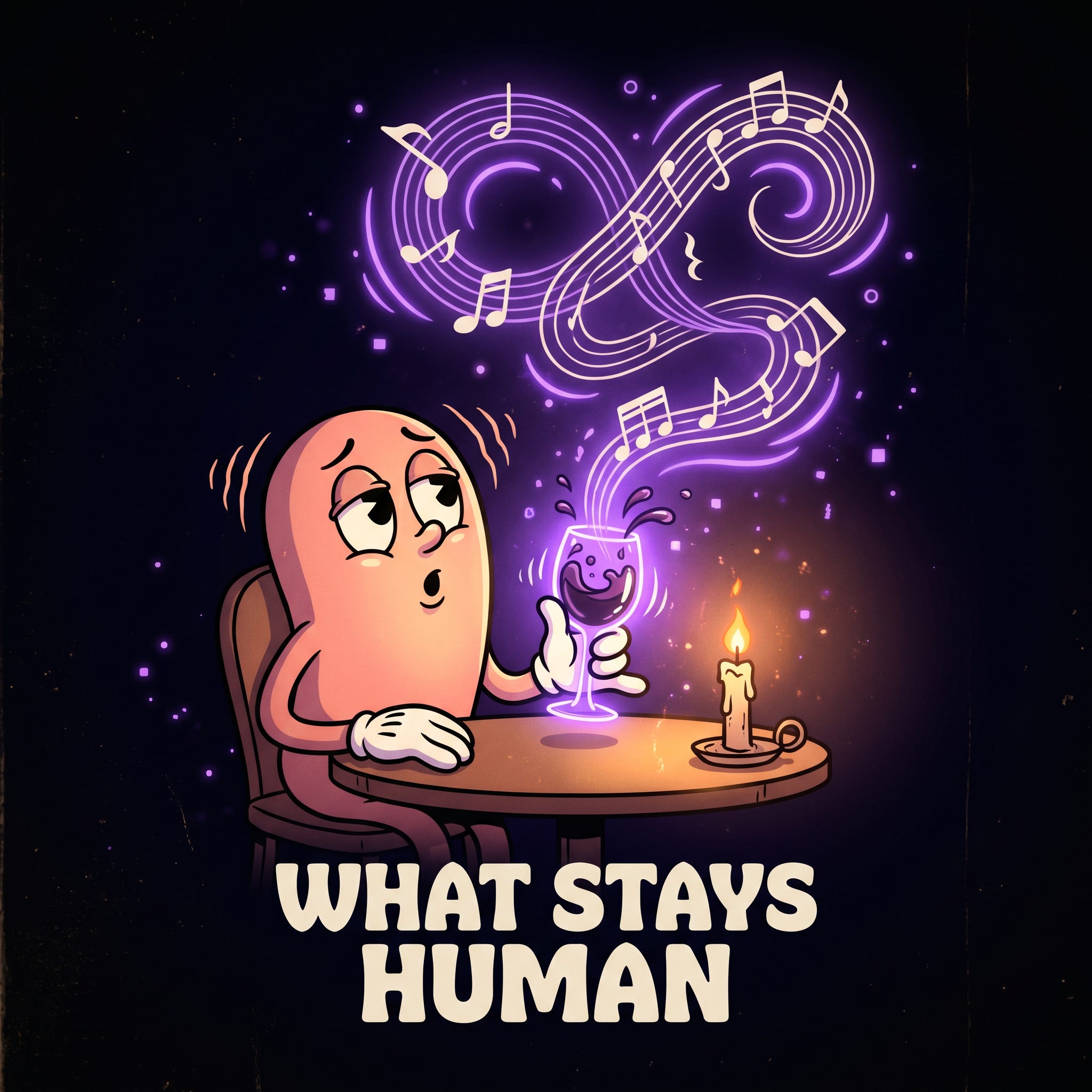
An artist named Francesco Sarcone was performing. Not playing instruments the way you would expect. He was working with the sound of wine. The pour, the swirl, the glass, all of it caught through sensors and turned into live electronic music. I watched the messy, accidental noise of a drink become something harmonic, in real time. No two seconds of it could ever repeat.
That evening is the reason this podcast finally came to life.
Because the machine in his work is real. The sensors, the software, the processing, all of it. And none of it is the point. The point is the human standing in the middle of the noise, deciding what it should become. The technology handed him a new instrument. It did not hand him the ear. The podcast was in ideation for quite some time. But that evening was where it became clear, how we are going to kick it off.
Because this is the part that reaches well past music. Strip the passion out of anything a person does and it decays the same way a skipped song does. It goes synthetic. The moment something is synthetic, a machine can make it by the million. So AI does not come for all of it at once. It comes first for whatever we already hollowed out, the work we stopped putting ourselves into, either because it never held much of us or because we slowly squeezed it out.
That is the seam I keep circling. Not human against machine, but the exact place where the machine carries the craft and only the human carries the meaning. In music it sits in one spot. In the way I build with AI, somewhere else. In your own work, somewhere else again. It keeps moving. It never disappears.
That seam is what Finding Resonance is about.
Every guest, every domain, the same question asked from a different angle. What becomes possible when humans and machines create together, and what stays irreducibly human when they do. With Francesco, the answer sounds like a glass of wine turning into a symphony. With the next guest it will sound like something else entirely. That is the part I find exciting.
The decay is real. I am not going to pretend otherwise. So I keep landing back on the question I started with. If we were already letting the soul leak out, long before any machine showed up, what are we actually fighting for?
I have half an answer. It has something to do with the person who hears what the noise could become. The other half I wanted from someone who lives inside the question, not next to it.
There is one thing those numbers quietly admit, though. The machinery only counts what we feed it. Forty-four percent of uploads against one to three percent of listening is not the algorithm’s verdict on what matters. It is ours. Every minute of attention is a vote, and the future gets built out of where we choose to spend it. We are not only watching the decay. We are funding it, or starving it, one hour at a time.
My conversation with Francesco Sarcone is the first episode of Finding Resonance. It drops this Thursday. We talk about the decay of music, what AI music gets right and completely misses, and the one thing he refuses to hand over.
Come listen. And then sit with the harder version of the question, the one I cannot answer for you. What in your own life still has your soul in it, and are you actually paying it your time?