
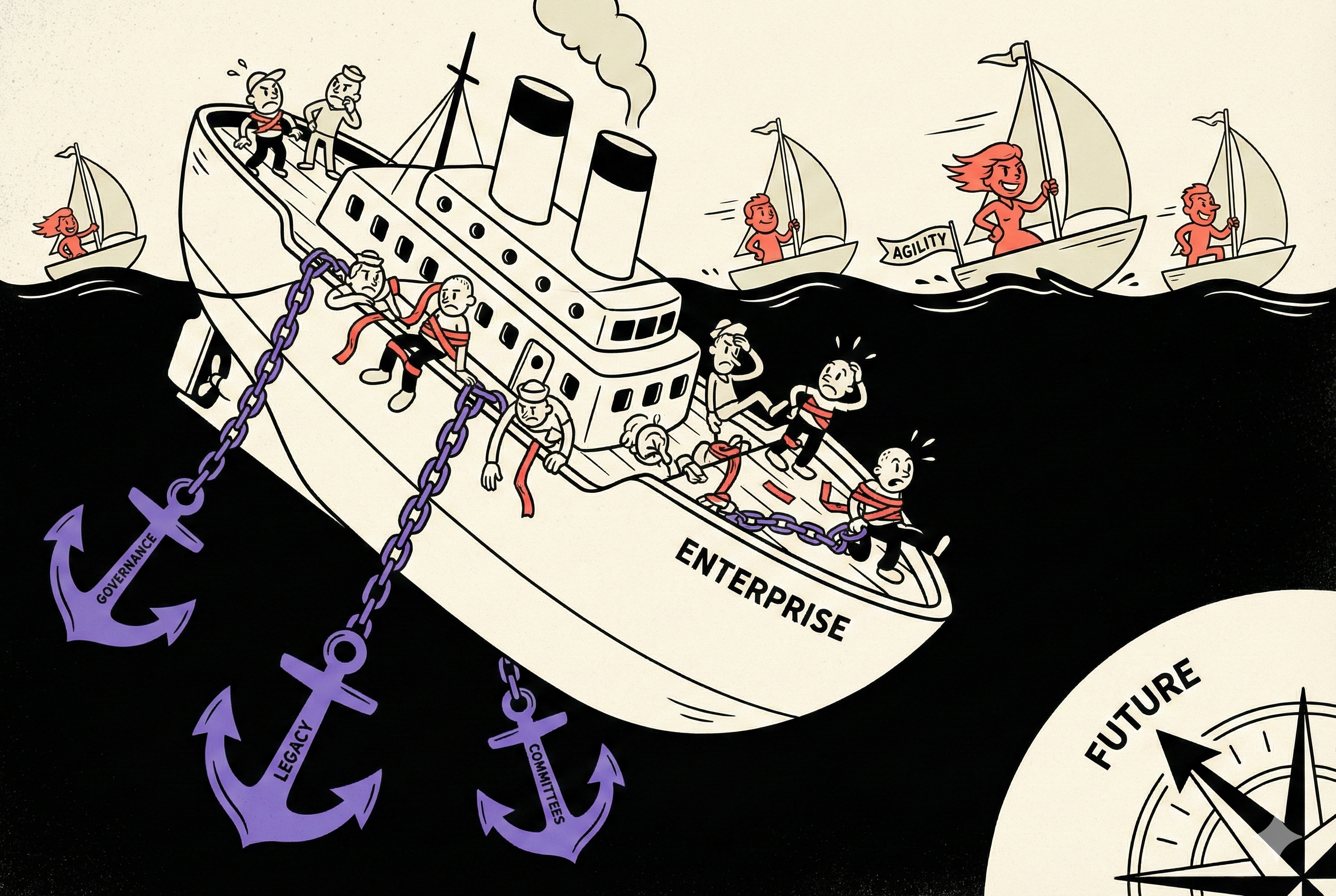
88% of enterprises are experimenting with AI, but 70% of those projects never move past the pilot stage.
Here’s what nobody’s saying: the barrier isn’t technology. It’s organizational weight. The same resources that helped large companies win for decades (big IT teams, governance frameworks, structured processes) are now anchoring them to the ocean floor while smaller companies sail past.
We’re witnessing an inversion of scale advantage. And most leaders haven’t realized it yet.
Let me explain.
The Four Eras
For thirty years, enterprise software followed a predictable pattern. You identified a need. You bought a massive platform. You used maybe 10% of its features. You paid for all of it.
This was the Big Systems Era. SAP. Oracle. Salesforce at enterprise scale. High cost, low utilization, but it made sense. Building custom software required massive capital and specialized teams.
Then came the Specialized SaaS Era. Instead of one monolithic platform, you bought focused tools. Project management here. CRM there. Analytics somewhere else. Less waste than before, but still paying for features you’d never touch. Still configuring workflows to fit the software instead of the other way around.
We’re currently living in the Composable Era. I call it the messy middle. You assemble best-of-breed tools and orchestrate them through integrations and APIs. It works. Kind of. Until you’re managing seventeen subscriptions, three integration platforms, and a full-time person just keeping the pipes flowing.
But look closer at what’s emerging beneath the surface.
We’re entering the On-Demand Creation Era. Not someday. Now.
You can already see this in the mainstream. Google just launched Disco, an experimental AI tool for the browser, powered by Gemini 3. Open a few tabs while researching a trip to Japan. Disco analyzes what you’re looking at and offers to build you a custom planning tool. Within a minute, it assembles a browser-based app with a map of Japan annotated with attractions, an itinerary builder, and links to all your sources.
No coding. No buying software. You describe what you need, and it builds it.
Google calls this feature “GenTabs.” You prompt the system with what you’re trying to accomplish, and it generates a custom interface with the information and tools you need. Studying a complex subject? It suggests building a visualization app. Comparing recipes? It offers to create a meal planner. The underlying AI handles all the logic and code generation.
This isn’t a developer tool hidden in some technical preview. It’s a consumer product from the world’s largest search company. The signal is clear: the era of describing what you need and having it built is no longer coming. It’s here.
What Changed
So what does the shift look like? We’re moving from buying functionality to describing functionality and having it built.
A team of three can now have custom software created for their exact workflow in days, not months. The economics have inverted. What used to require a $200,000 development project and six months of vendor management can now happen in a week with one technical person and AI assistance.
I’ve seen this firsthand. I have built an entire web application (front end, back end, deployment pipeline) in under a week. No external developers. No massive budget. Just describing what we needed and iterating with AI until it worked.
The research backs this up. According to analysis from Menlo Ventures, startups now hold 71% market share in product and engineering tools, including code generation, beating enterprise incumbents who had every structural advantage. Why? They shipped faster. They experimented more. They weren’t slowed down by governance committees.
Businesses implementing custom solutions report an average ROI of 55% over five years, compared to 42% for SaaS implementations, according to Gartner data.
The math is changing.
The Paradox Nobody Talks About
Here’s where it gets interesting: small companies now have the advantage.
I know. It sounds backwards.
Large companies have more resources. Bigger budgets. Established IT departments. Access to the best tools and platforms. They should be winning this race.
But they’re not.
Research from McKinsey found that while 88% of enterprises are using or experimenting with AI, only 33% have deployed it across their organizations. The gap between experimentation and deployment reveals a leadership challenge, not a technology one.
When you’re a company of thousands, every AI initiative needs governance frameworks. Cross-functional committees. Risk assessments. Compliance reviews. Security audits. Change management processes.
When you’re a team of eight, you just... build it.
Academic research on AI adoption in smaller firms points to the same conclusion: agility and willingness to take risks give startups a distinct advantage with disruptive technologies. While large firms leverage substantial R&D resources for incremental innovation, smaller firms lead with technologies like AI that reward speed over scale.
The same attributes that made large companies successful in the Big Systems Era (formal processes, structured decision-making, coordinated rollouts) are now liabilities. Your advantage doesn’t come from the tools themselves. It comes from your ability to move.
What This Actually Looks Like
Let’s get concrete.
A small recruiting firm needs a candidate tracking system. The SaaS options are either too simple or too complex. Too expensive or too limited. Nothing quite fits.
In 2020, they would have compromised. Bought the closest fit. Configured their workflows to match the software.
In 2025, they describe their exact process to an AI-assisted developer. Custom candidate pipeline. Automated follow-ups specific to their approach. Integration with their existing tools. Built in two weeks. Owned completely. Modified whenever they need.
A boutique consulting firm wants a proposal generation system that pulls from their IP library, adapts to client contexts, and maintains their voice. No SaaS tool does this.
They don’t need to find one anymore. They build it. Custom. Exact. Theirs.
The difference is speed of execution. Small companies decide on Monday and deploy on Friday. Large companies form committees.
The Trap Large Companies Are In
Here’s the paradox large companies face: organizations with comprehensive governance models struggle to move fast. Organizations without them can’t scale safely. Either way, they lose ground to smaller competitors who don’t face this tradeoff.
Large enterprises also face integration nightmares with legacy systems. Nearly 60% cite integrating with existing infrastructure as their primary barrier to AI adoption. Their data sits in incompatible formats across siloed departments. Custom development requires coordinating multiple teams, navigating bureaucracy, securing budget approvals.
Small companies don’t have legacy systems holding them back. They’re not coordinating seventeen stakeholders. They’re not managing vendor relationships or negotiating enterprise contracts. They’re building what they need and shipping it.
The research is clear: organizations without structured governance experience faster initial deployment but struggle to scale. Organizations with comprehensive governance move slowly but systematically. Both approaches have costs.
But in an era where technology capabilities double every eighteen months, speed matters more than perfection.
Now, what does that mean for leaders?
If you’re running a small company, you’re sitting on an advantage you might not realize you have.
The keys to the future are already in your hands. The only question is whether you recognize it.
You don’t need a massive IT budget. You don’t need governance frameworks designed for thousand-person organizations. You don’t need to compromise your workflows to fit off-the-shelf software.
You need three things:
1. A willingness to experiment. Not pilot programs and steering committees. Actual experimentation where someone on your team describes a problem and builds a solution. Fast feedback loops. Quick failures. Rapid iteration.
2. One technically-capable person. Not a full development team. One person who can work with AI tools to create custom functionality. This is becoming a core business skill, not a specialized technical role.
3. Permission to move faster than feels comfortable. The protective instinct to “wait until we have it figured out” is the same instinct that lets larger, slower competitors catch up. In 2025, building beats buying in speed, fit, and cost.
According to Salesforce’s SMB Trends Report, growing small and mid-sized businesses are the primary drivers of AI adoption. 83% are already experimenting. 78% plan to increase investments. The gap is widening between AI-native small companies and those waiting for the “right time.”
The Choice Point
We’re at an inflection point.
For the first time in modern business history, being small is a software advantage. You can build exactly what you need, faster than enterprises can evaluate what to buy.
But this window won’t stay open forever. As more small companies realize this advantage and act on it, competitive pressure increases. The companies moving now are building capabilities. The ones waiting are falling behind.
Large companies will eventually solve their governance challenges and integration problems. They’ll figure out how to move faster. But that takes time.
That’s your window.
You can keep shopping for SaaS tools that almost fit. Keep paying for features you’ll never use. Keep configuring your business to match software designed for someone else.
Or you can start describing what you actually need and building it.
The technology is here. The economics work. The only barrier is recognizing where you stand.
What To Do Next
If you’re a small company leader reading this, here’s your action plan:
This week: Identify one workflow where you’re compromising because existing software doesn’t quite fit. Not your biggest problem. Just one clear example.
Next week: Describe exactly how that workflow should work in your business. Not how the software makes you do it. How you would design it.
The week after: Find one technical person, internal or external, who can work with AI tools to build a prototype. Give them your description. Set a two-week timeline.
Don’t aim for perfect. Aim for working. You can iterate from there.
The companies that figure this out first will have an advantage measured in years, not months. They’ll have systems built exactly for their needs. Software that evolves with their business instead of constraining it. Competitive moats built on custom capabilities, not purchased platforms.
This is the shift. The era of buying software is ending. The era of building exactly what you need is beginning.
The question isn’t whether this is happening. It’s whether you’ll be early or late.
---
*If this resonates but you’re not sure where to start, that’s exactly what I help companies navigate. I run 5-day AI Adoption Sprints where teams go from “we should probably do something with AI” to deployed, working solutions. We don’t just talk about possibilities. We build them.*
*And for leaders who see the vision but need execution support, I offer Done-for-You Automation where we build your custom solutions in 1-2 weeks. You describe the need. We deliver the working system.*
*2025 is the year to stop buying software and start building it. Let’s make sure you’re not still shopping while your competitors are shipping.*
---
Research Sources:
- [Google Blog: Disco and GenTabs](https://blog.google/technology/google-labs/gentabs-gemini-3/)
- [TechCrunch: Google Debuts Disco](https://techcrunch.com/2025/12/11/google-debuts-disco-a-gemini-powered-tool-for-making-web-apps-from-browser-tabs/)
- [McKinsey: The State of AI in 2025](https://www.mckinsey.com/capabilities/quantumblack/our-insights/the-state-of-ai)
- [Menlo Ventures: 2025 State of Generative AI in the Enterprise](https://menlovc.com/perspective/2025-the-state-of-generative-ai-in-the-enterprise/)
- [Salesforce: SMB Trends Report](https://www.salesforce.com/resources/research-reports/smb-trends/)
- [Netguru: SaaS vs Custom Software Guide (Gartner data)](https://www.netguru.com/blog/saas-vs-custom-software)
- [Deloitte: AI Adoption Challenges and Trends](https://www.deloitte.com/us/en/services/consulting/blogs/ai-adoption-challenges-ai-trends.html)