
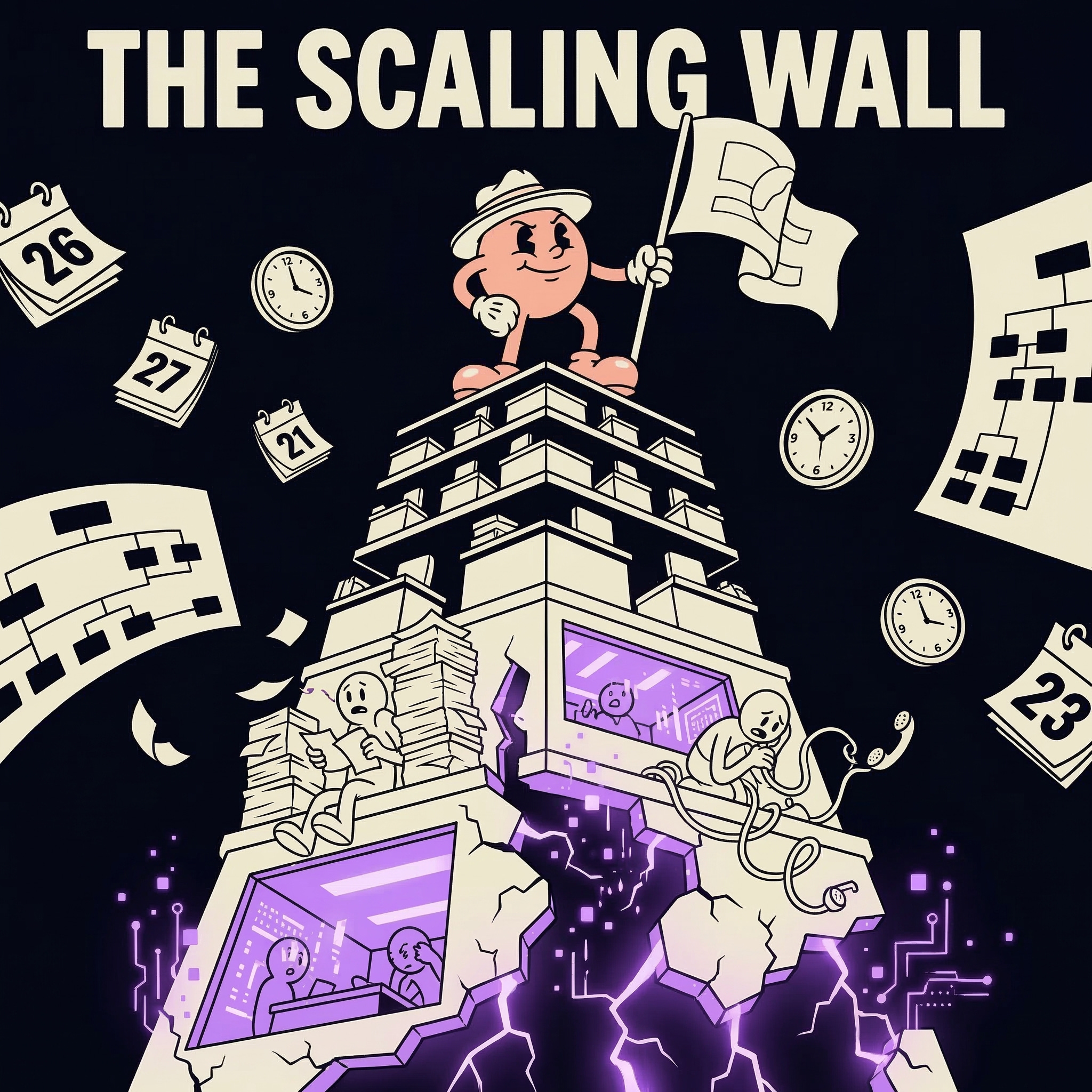
The company hits product-market fit. Revenue grows. The team doubles from 10 to 25. Then something breaks.
Not the product. Not the market. The machine around the product.
Operations starts eating everything. The CTO stops building and starts firefighting. Every new hire adds coordination overhead that nobody budgeted for. And the CEO sits in a room with a growing team, thinking: “We know where we need to go. We can’t get there with what we have.”
I hear some version of this in almost every discovery call.
The Wall
I call it the scaling wall. It shows up somewhere between 15 and 35 people.
What worked at 10 stops working. The informal processes, the quick Slack messages, the “everyone just knows what to do” culture. All of it collapses under its own weight.
And the instinct is to hire. Stretched? Hire. Drowning in admin? Hire. CTO can’t keep up? Hire a second one.
Premature scaling contributes to 74% of high-growth startup failures. Not because the market wasn’t there. Because the internal systems couldn’t support the growth.
Hiring creates coordination overhead, more meetings, and pulls people further from product. Worklytics’ 2025 engineering benchmarks found that the median engineering team already spends 28% of its workday in meetings. At the 25th percentile, that number hits 35%. Coding time drops to 22% of the day.
Your most expensive people, doing their most valuable work, less than a quarter of the time.
Where the Gap Opens
Teams are strong. The gap between where the company is and where it needs to go just can’t be closed by adding headcount alone.
“Operations is eating us alive.”
I hear this exact phrase. Not my words. Theirs.
The CEO feels it as growth slowing down despite hiring. The CTO feels it as context-switching between operational fires and product roadmap. The team feels it as everyone doing three jobs, most of which aren’t the job they were hired for.
Techreviewer’s 2026 research backs this up: 72% of companies rate their talent pool as strong, yet 53.7% still can’t find candidates with the skills they actually need. The talent is there. The fit rarely is.
The capability gap runs deeper than hiring can reach.
Breaking Through
The companies I’ve seen get past the wall share a common move: they name the constraint before deploying resources.
Not “we need more people.” Instead: “Our CTO spends 40% of their time on non-product firefighting. That’s the constraint.”
Naming it changes everything. You stop solving “growth” in the abstract. You solve one specific bottleneck that’s capping your team’s ability to focus on product.
Then they fix systems before hiring. Every operational bottleneck you automate is a hire you don’t need to make. And unlike a hire, automation reduces coordination overhead instead of adding to it.
The math is straightforward. If your senior team spends 60% of their time on non-product work, that’s 60% of a CHF 180k salary going to tasks that don’t move the company forward. Fix the top three time sinks and you’ve freed up more capacity than a new hire would bring, without the onboarding curve.
And they start small. No 12-month roadmap. No strategy deck that pulls people off product for two weeks to read. One bottleneck. One solution. Working software by the end of the week.
One solved problem creates belief. Belief creates the next solved problem.
Why This Stays Stuck
None of this is technically hard.
The hard part is cultural. The CEO who believes hiring is the answer because hiring has always been the answer. The CTO who can’t let go of the firefighting because if they don’t do it, who will. The team so deep in “keeping the engine running” that they can’t imagine a world where the engine runs itself.
The scaling wall looks like a growth problem. The bigger issue is systems. And systems can be redesigned.
One Question to Start
If you’re running a 15-35 person company and you recognize this pattern, start here: where is your CTO spending their time?
If the answer is “operational fires,” that’s your constraint. Name it. Then look at the top three tasks eating your team’s product time. Those are your targets. And ask whether you can fix one of them in a week. The answer is almost always yes.
The capability gap is real. It also closes faster than most founders expect, once they stop adding headcount and start fixing what’s underneath.
The best teams I work with don’t need more people. They need their people back on product.